Lighting Language for AI Photos: The Terms That Actually Change the Image
Lighting is the single biggest lever in a photography prompt, and it is the one most people describe with a shrug: 'good lighting', 'nice light', 'cinematic'. Real photographers name the source, its direction, its size and its colour, and image models respond to that vocabulary because it appears in millions of captions written by people who knew what they were doing.
Direction Sets the Mood
Front light flattens and flatters, side light sculpts and dramatises, back light separates and romanticises. If you only change one word in a prompt, change the direction and watch the emotional register move with it. 'Soft light' with no direction is a coin toss; 'soft light from camera left, slightly above eye level' is a decision.
- Rembrandt: a triangle of light on the shadow-side cheek. Classic, serious, painterly.
- Clamshell: a source above and a reflector below. Even, flattering, beauty-campaign polish.
- Rim or kicker: a hard edge from behind. Separates the subject from a dark background.
- Backlit with haze: glowing outline, dreamy, slightly nostalgic.
- Split light: half the face lit, half in shadow. Tense and graphic.
Quality Is About Source Size
Hard or soft is not a style choice, it is physics: a big source relative to the subject gives soft, gradual shadows; a small one gives crisp, defined shadows. Saying 'large gridded softbox' or 'bare bulb at three metres' tells the model both the softness and the believability of the falloff. That is why naming actual equipment works better than naming a feeling.
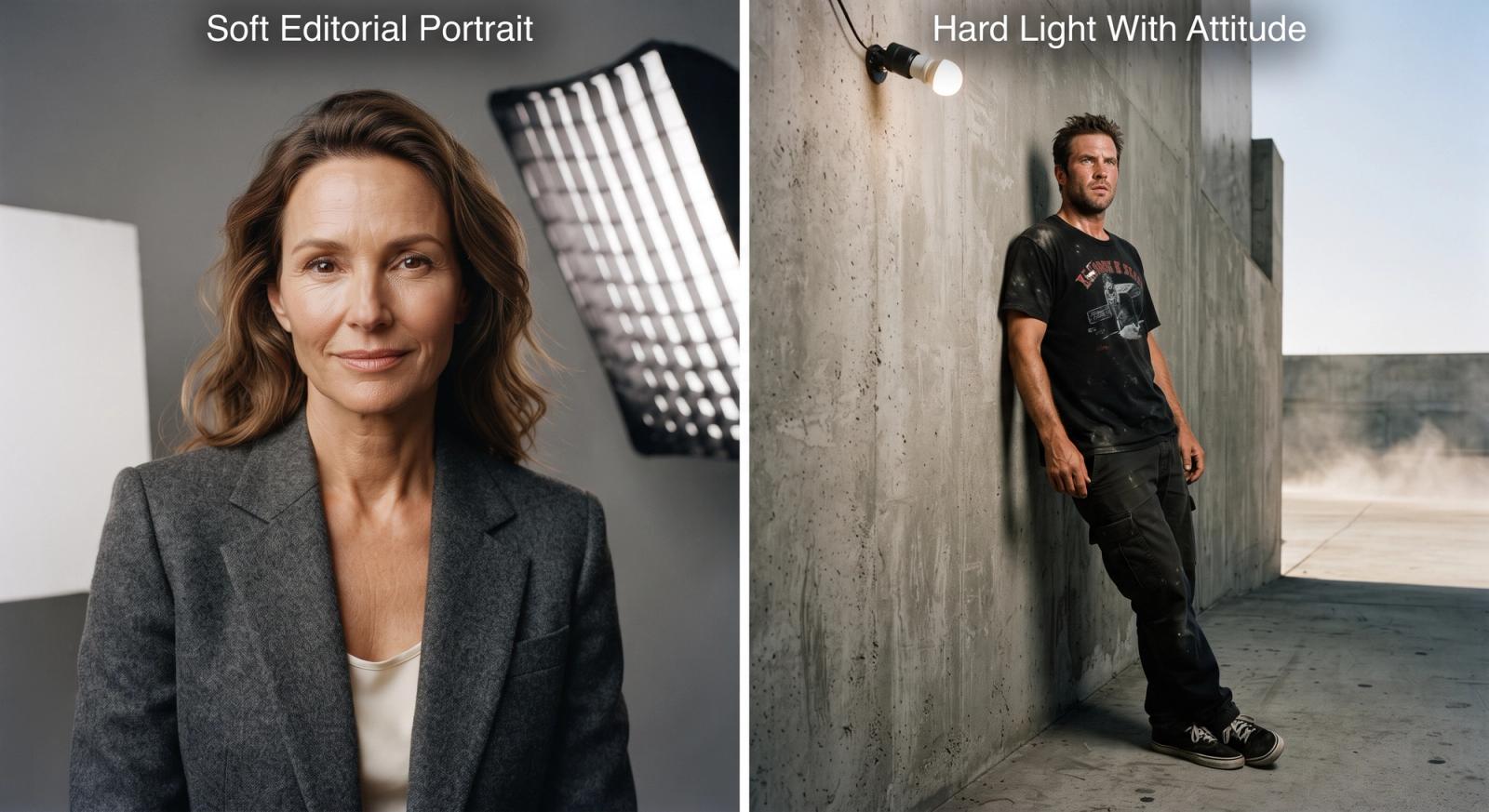
Soft Editorial Portrait: Studio portrait of a woman in a charcoal blazer, large gridded softbox as key from camera left at 45 degrees, white bounce card filling the shadow side, seamless grey backdrop, shot on a Hasselblad with a 100mm lens at f/4, natural skin texture, editorial colour, photorealistic
Hard Light With Attitude: Portrait of a skateboarder against a concrete wall, single bare-bulb flash high and slightly right creating crisp shadows and deep falloff, no fill, midday heat haze, shot on a 35mm lens at f/5.6, punchy contrast, fine grain, photorealistic
Colour Temperature Is Story
Warm light reads as memory, comfort and late afternoon; cool light reads as clinical, modern or nocturnal. Mixing them deliberately is what makes a frame feel filmic: a warm key with a cool practical in the background gives you depth that a single colour cannot. Say it plainly — 'warm tungsten key, cool blue window light behind' — and the model will separate the two.
Do Not Stack Contradictions
The most common lighting mistake in AI prompts is asking for two incompatible looks at once: 'high key, moody, dramatic shadows, bright and airy'. The model will average them into something muddy. Pick a register and commit. If you want contrast within a bright image, describe it precisely — 'bright and airy overall with one crisp shadow under the jaw' — rather than piling on adjectives that cancel out.
- Name one key light, then at most one fill and one accent. Three sources is a lot for a single frame.
- Golden hour and blue hour are times of day, not lighting setups — pair them with a direction.
- If skin looks waxy, the problem is usually too much fill; ask for 'unfilled shadow side' and grain.
- Add 'catchlights visible in the eyes' to portraits; it is the fastest realism cue there is.
Learn eight or nine of these terms properly and you will stop fighting your prompts. Lighting language is the difference between asking for a photo and directing one.